#PRODUCT DESIGN #AI-NATIVE DESIGN #PRODUCT STRATEGY
Turning a $26M compliance platform into an AI-native product
C&R had $26M ARR in a legacy compliance platform and customers were leaving — the effort to maintain it was too high. I was brought in to define and lead the AI-first replacement, starting with validating demand before committing to the build.
COMPANY
Compliance & Risks
ROLE
Senior Manager, Product Experience & Market Insights
TIMELINE
2024–2026
THE SITUATION
A $26M legacy platform losing customers to effort, not competitors
C&R had a $26M ARR legacy compliance platform — 393 customers, built around expert-led manual workflows. Customers were leaving, not because a competitor was better, but because the product demanded too much effort to maintain. $3.76M was explicitly at risk, another $9.3M sat in a sensitivity band.
The decision to build an AI-first automated replacement had been made before I joined. I was brought in to define and design that product myself — in close partnership with the PM — starting with what the manual version actually demanded of people, before designing what should replace it
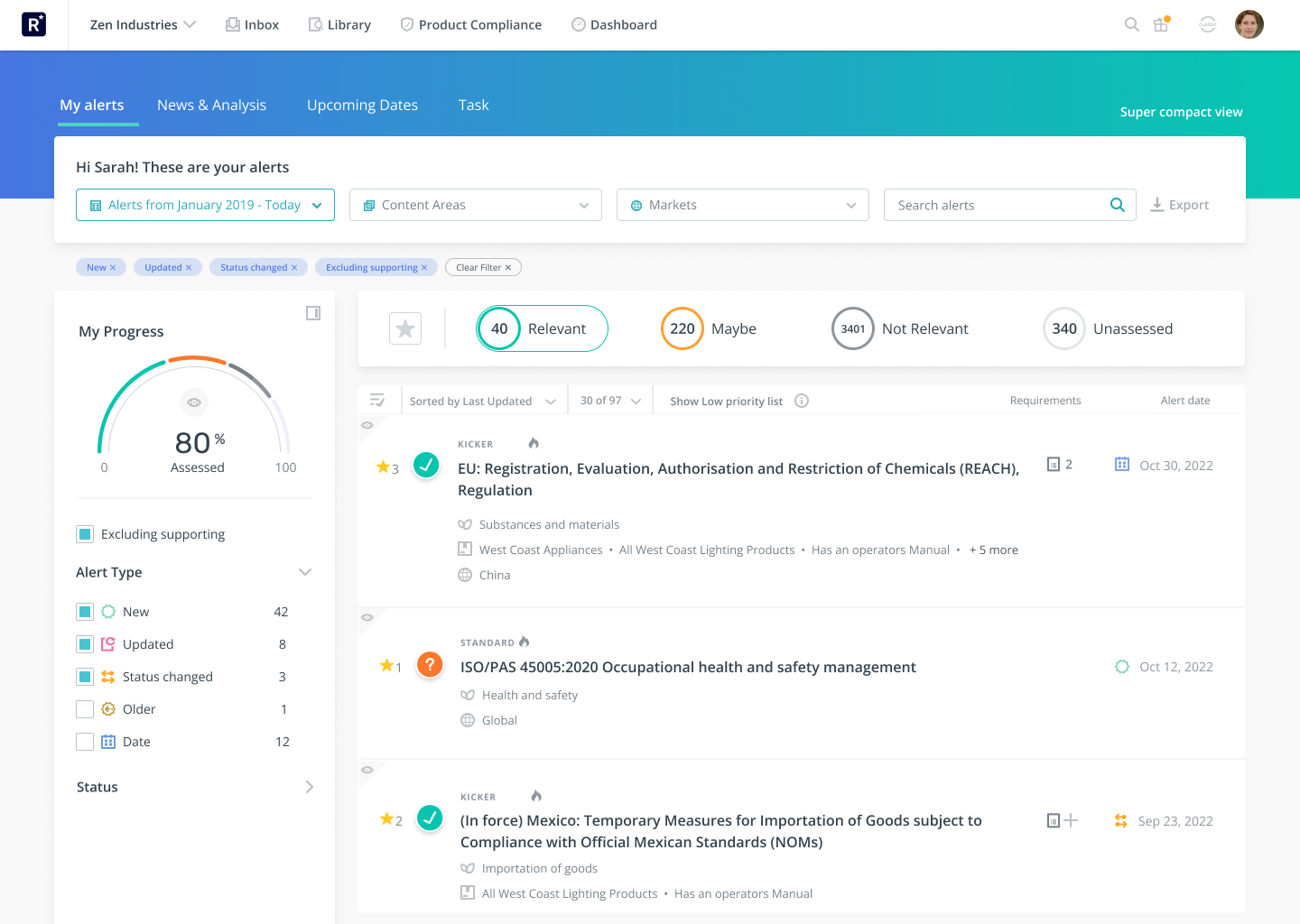
Before: compliance experts manually reviewed thousands of regulatory alerts, reading each one in full to extract what it actually required of the business. Weeks of expert time before a single decision got made — this screen is the cost we were designing away.
DESIGNING FOR TWO VERY DIFFERENT USERS
Who is this for, and what do they actually need to see?
Before any of this got built, I had to answer a basic design question: who is this for, and what do they actually need to see? Early discovery surfaced two very different audiences sitting on top of the same compliance data — a P&L owner who thinks in revenue and risk, and a compliance leader whose job is still the regulation itself. I designed concept directions for both, in parallel, to find out how far the same underlying intelligence could stretch before it needed to look like two different products.
For the P&L owner, compliance disappears into the number that matters to them — revenue at risk, margin impact, market opportunity. Text-first, not a dashboard, deliberately.
For the compliance leader, the same engine, recalibrated: compliance-specific risks, strategic and ESG trends, a clear "what to do next." Same underlying assessment as the P&L view — different altitude, because the job is different.
That split became one of the behavioural design principles I carried through the rest of the product: answer the user's question, not the dataset. Showing everyone the same regulation list overwhelmed both audiences for different reasons — too commercial for the compliance leader, too granular for the P&L owner. Designing two lenses on one dataset, instead of one screen for everyone, was the actual unlock.
TURNING ASSESSMENT INTO ACTION
From "here's what's required" to "here's what it costs you, and here's an agent to ask"
The compliance-leader direction evolved further into what was branded as the Action Center — the clearest example in this product of automation doing real work, not just displaying it. Every assessed regulation becomes a costed action: cost to comply, revenue at risk, revenue opportunity, owner, and due date, sitting next to a conversational agent for anything that needs more context than the table gives
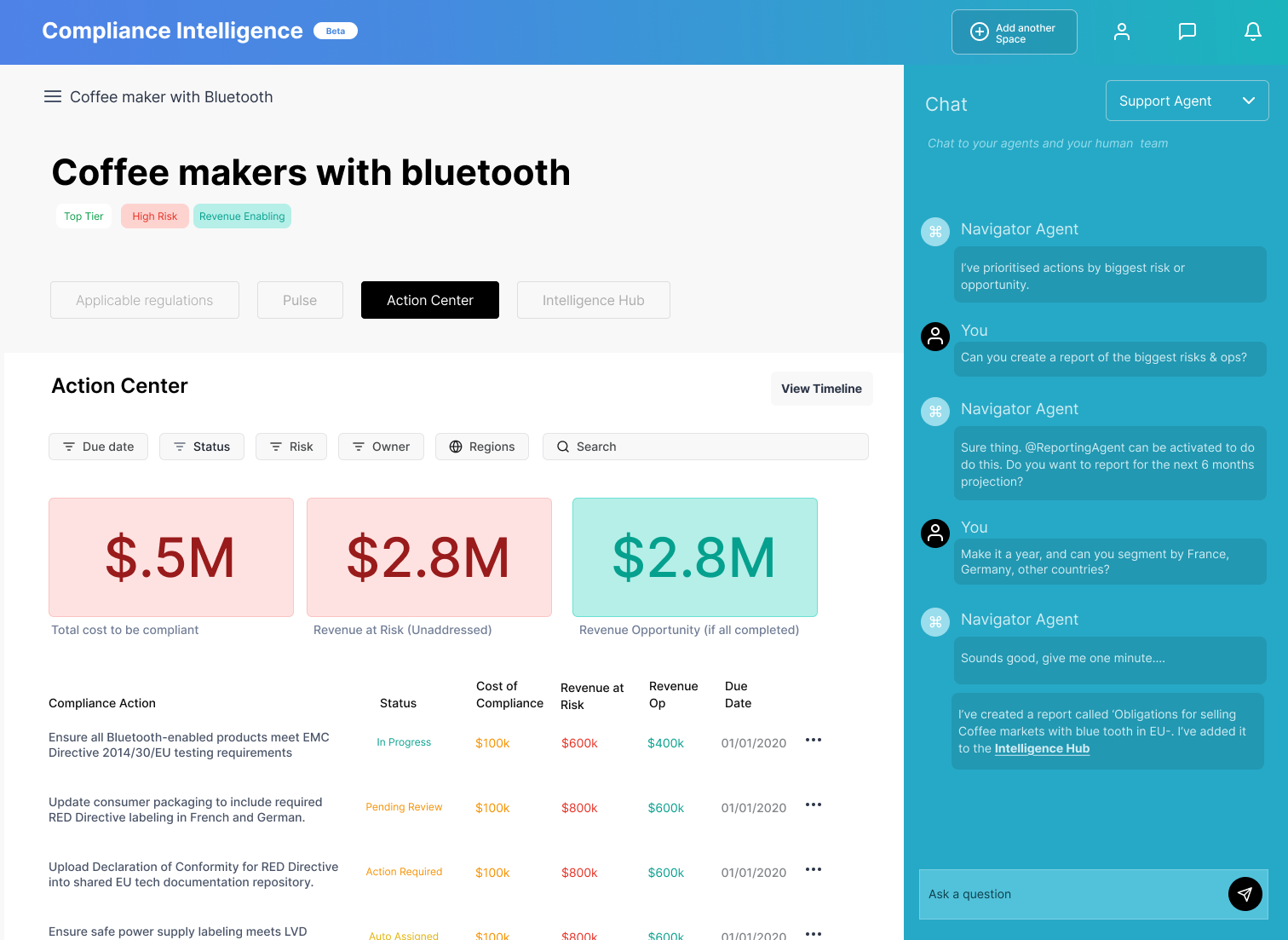
Screenshot of the AI assisted action center
Assessed regulations become costed actions automatically — compliance cost, revenue at risk, revenue opportunity, per action — with an agent on hand for anything that needs more context. The system isn't just reporting requirements, it's pricing the decision and giving the user a way to push back on it in plain language.
This is where the system must explain itself — another of the principles I led the team to define later, once we'd scaled past one person making every call — started as a concrete interaction choice, not an aspiration: visible reasoning, an editable assessment, and an agent you could question, rather than a verdict you had to trust blin
V1 SUSTAINABILITY, SHIPPED AND VALIDATED
Validate the AI-first bet on the smallest, lowest-risk vertical first
Full product compliance was the core business, but also the most complex entry point. Together with the PM and executive team, we chose to validate the AI-first approach through a Sustainability vertical first — lower regulatory complexity, faster path to a testable product.
I led discovery to understand what compliance SMEs and business leaders actually needed from an automated system, what would block adoption, and what "good enough to trust" looked like in this domain — then designed and shipped V1 myself, and led validation with early customers.
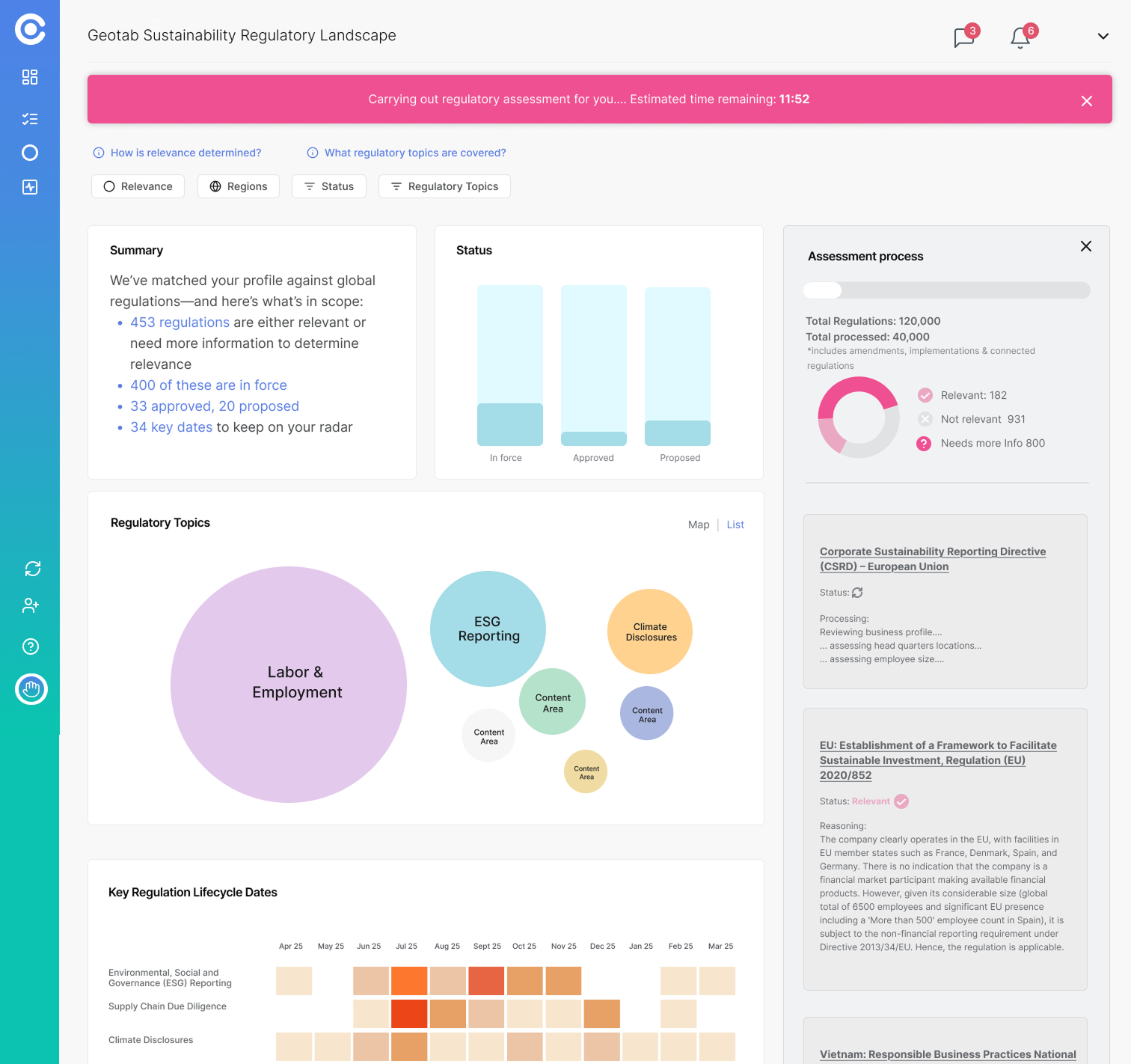
Live: the system matches a company's profile against thousands of ESG regulations in minutes — work that used to take an expert weeks to months of assessing & manual cross-referencing.
The progress panel and banner was a deliberate design choice, not a loading state: showing the system actively working builds trust in something this consequential, instead of dropping a finished answer with no visible reasoning.*
Results: Net-new revenue, protected at-risk ARR, and onboarding cut from weeks to minutes
Within the first quarter of beta:
~20 paying customers, ~$500k ARR, including enterprise accounts like ABF and Starbucks. More importantly, it told us exactly what was blocking broader adoption — content credibility and coverage confidence. That evidence shaped everything that came next.
LEARNING FROM SUSTAINABILITY RELEASE INFORMED THE AI STRATEGY
Right answers weren't enough — users needed a baseline they could trust first
The first version of V1 shipped full AI automation — it was accurate, but users focused on what was wrong rather than what was right. Onboarding stalled. I redesigned the sequencing: deterministic logic first, AI refinements layered on top second. That gave users a fast, reliable baseline before surfacing AI judgement calls. It shifted the experience from "prove the AI is correct" to "here's a starting point you can already trust."
V2 PRODUCT COMPLIANCE - REFRAMING THE VALUE
From ‘Assess this regulation’ to “Can I sell here?’
With V1 validated, I led design of the next product: full Product Compliance, the core business line. Same approach — discovery, close customer liaison, definition before engineering commitment, then design. The reframe that came out of that work changed what the product was actually for:
From: Assess each regulation manually
To: Can I sell this product in this market, and what do I need to do?
Determining if a product can be sold in a new market has been reduced from months to minutes
Products can be set up and start monitoring their products. Executive reports are generated daily to get an at a glance overview to risks and required actions
ADOPTION FOLLOWING RELEASE
The migration off the legacy platform was run as a product plan, not an ops handover
Two things outside the interface mattered as much as anything on screen. The migration off the legacy platform was run as a product launch, not an ops handover — the first cohort was ~$200k ARR, chosen for low complexity, used to build the playbook before touching higher-risk accounts.
And the biggest adoption risk wasn't the system — it was whether compliance SMEs, whose professional identity was tied to doing this work manually, would actually use it.
They weren't resistant because the AI was wrong. They were resistant because automation challenged their expertise.
That's why the experience for the executive and the compliance leader stayed deliberately different. The executive cared about business impact, revenue risk, and the biggest strategic exposures — not the regulations driving them. The SME's head was still in the detail: verifying the system had classified regulations correctly, tracing each action back to its source regulation, and being able to edit where needed. That granularity wasn't extra — it was how the SME built trust in a system that was now making calls they used to make themselves.
IMPACT
Net-new revenue, protected at-risk ARR, and onboarding cut from weeks to minutes
~$500k net new ARR from zero (Sustainability vertical)
9 new logos, 7 upsells/retention saves, 4 renewals in first phase
$3.76M at-risk ARR in active protection motion
Onboarding time: weeks (solution engineer-led) → minutes (self-serve)
Sales cycle: ~5-month enterprise cycle → self-serve / faster conversion
V1 → V2 shipped, ~30-customer beta, positioned for scale
WHAT THIS TAUGHT ME
A correct AI is not enough. Users need to understand why before they will accept and act
That's a design problem before it's an engineering one — visible reasoning, the right altitude for the right user, a baseline they can trust before you ask them to trust the AI on top of it.
And adoption is the product. The system working is a necessary condition, not a sufficient one. The question is always: will the right people actually use this in their daily workflow, and did the design earn that?